Installation
Barn, Shop And RV Doors On Acreage: What Changes
A fourteen foot shop door is not a house door made bigger. Here is what changes once the weight goes up, and the things a city installer misses on a property outside town.
The short version
- Door weight scales with area, so springs, torsion shaft, bearings, drums and cables all get specced together and changing one changes the math for all of the rest.
- High lift or vertical lift track puts a tall door up out of the working space, and a jackshaft or hoist operator beats a ceiling trolley, with the hoist's chain fallback earning its keep on a property that loses power.
- Tracks on a dusty property get wiped clean and never greased, because grease turns caliche and pasture dust into grinding paste that makes rollers drag.
- A shop door opened a handful of times a day does not need high cycle springs, while a door running twenty or thirty cycles a day burns a standard 10,000 cycle set in about a year.
A fourteen foot tall shop door is not a house door made bigger. It is a different weight class, and every part downstream of the weight changes with it.
That explains most of what goes wrong on acreage in Parker, Wise, Hood, Johnson and Somervell counties. Somebody specs a barn or shop door the way they would spec a two car door in a subdivision, and the springs, the shaft, the track and the operator all end up one size behind the job.
Weight scales with area, and the whole counterbalance follows it
Weight goes up with square footage, and a shop door has a lot of it. A sixteen by fourteen opening is more than double the area of a sixteen by seven house door, and the sections are usually heavier gauge on top of that. The counterbalance is not one part you upsize. It is a system, and every piece gets specced together.
- Springs. Wire size, inside diameter and length chosen for the finished door weight and the drum size, not for the opening dimensions.
- The torsion shaft. A long shaft on a wide heavy door has to resist twisting along its length, so it goes up in diameter and sometimes to solid stock.
- End and center bearings. More load and more span means more bearing plates along the shaft, not just heavier ones at the ends.
- Cable drums. Drum size sets how much cable pays out, so a fourteen foot door needs drums rated for that lift, and high lift track needs a drum profile made for it.
- Cables. Sized to the load with a safety factor, and never carried over from whatever was hanging there before.
Change one and the math changes for the rest. That is why a tall door is a spec sheet, not a catalog pick.
Standard track usually will not work in a shop
In a house, standard track curves the door back to horizontal just above the opening. That is fine, because the ceiling was low anyway. In a shop with twenty feet of clear height, it throws all of that away and parks the open door right where you wanted a light, a hoist, or storage.
High lift track raises the curve. The door runs straight up past the opening for a set distance before it turns back, which lifts the horizontal track and the parked door out of the working space. Vertical lift goes all the way and runs the door straight up with no horizontal section at all, which needs clear height above the opening greater than the door height plus room for the hardware.
The trade is headroom. High lift needs the lift distance plus the normal radius allowance, and the torsion shaft moves up with it. So the measurement that matters is clear height to the lowest obstruction, not to the peak. A truss chord, a light fixture or a sprinkler line is what the door has to clear.
Operators: jackshaft, hoist, and the chain you will be glad you have
A ceiling trolley operator, the rail and chain unit that hangs over a house door, is the wrong tool here. The rail has to hang from something, the run gets long, and on high lift or vertical lift track there is no horizontal rail to hang it from at all.
A jackshaft operator mounts on the wall beside the torsion shaft and drives the shaft directly. Nothing over your head, nothing hanging off a truss, and it works with high lift and vertical lift track.
A hoist operator does the same work and adds a chain fallback, so the door can be moved by hand when the power is out. Outside town that is not a convenience feature. When a line goes down after a storm in Parker County and stays down a day, the difference between a truck locked in a shop and a truck you can get out is a hand chain.
Struts, wind load, and why RV doors hit three problems at once
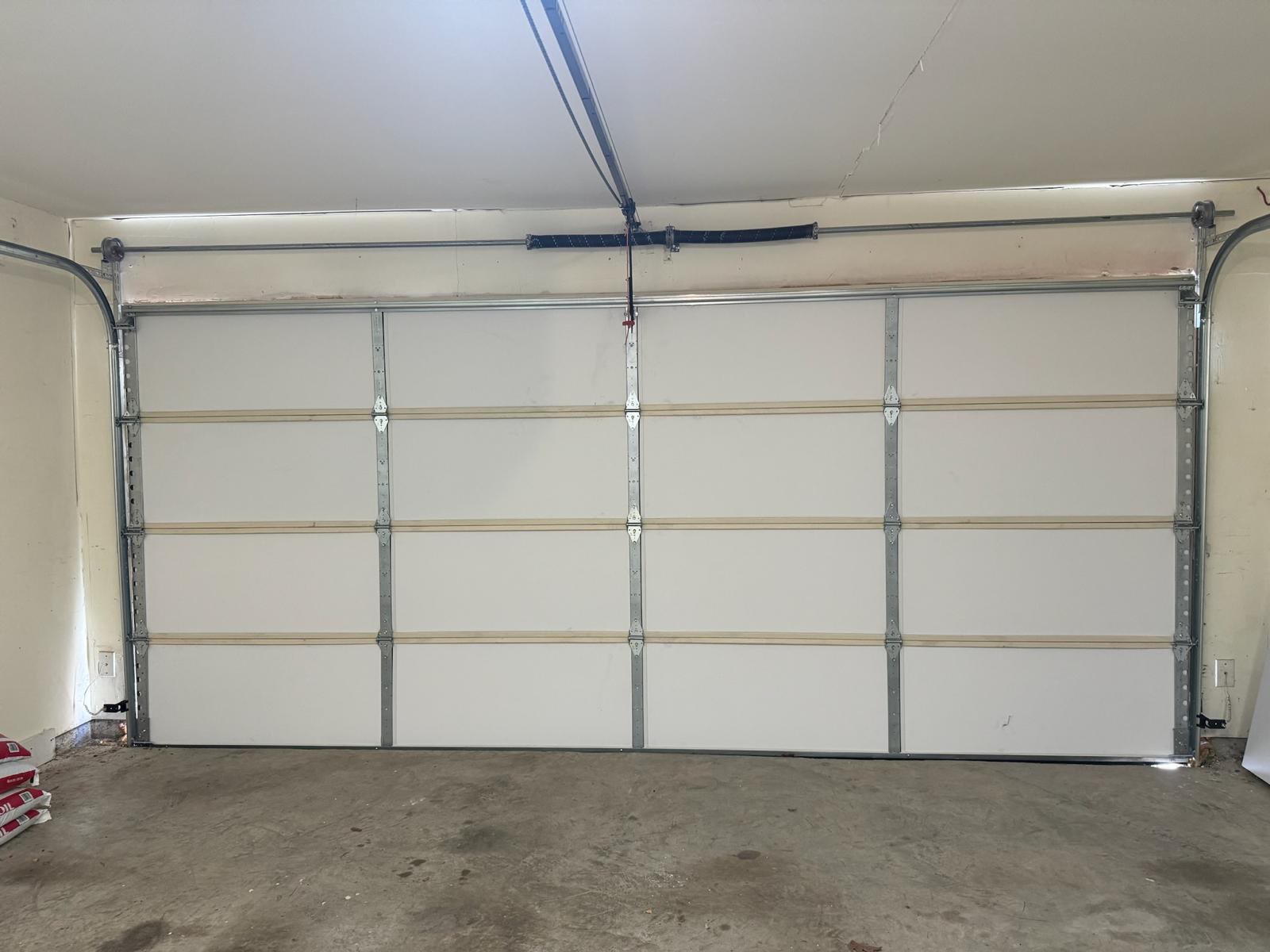
A wide door needs help holding its shape. A strut on every section is normal on a wide opening, not an upgrade. A strut is a horizontal reinforcing bar across the back of a section, and it stops the section bowing under its own weight and the operator's push. Without them the door sags in the middle, the rollers load unevenly, and the top section flexes where the operator arm attaches.
Wind is the other one. An acreage opening is exposed in a way a subdivision opening is not, and a large door is a large sail. Ask what the wind load rating is, not whether the door is rated. A rated door means heavier gauge sections, extra struts, and stronger track and jamb attachment.
RV doors hit all of it at once. Tall, so track type and headroom come up. Heavy, so the counterbalance is a calculation and not a lookup. Usually on the exposed side of a building, so wind load applies. And the height is the number people get wrong, because they measure the coach, forget the roof air conditioner and the antenna, then forget that the hardware eats into the clear opening at the top.
Dust, rodents and the things a town install misses
This is the part a company that only works in town skips.
Caliche and pasture dust cake onto track and roller bearings. Grease makes that worse, not better, because grease in a track turns dust into grinding paste and the rollers drag instead of rolling. So the rule on a dusty property is simple. Tracks get wiped clean and never greased. Lubricant belongs on hinge pivots, roller stems, bearings and spring coils, and nothing goes in the track.
- Wipe the track with a dry rag, or a little solvent if it is caked. No grease, ever.
- Use sealed nylon rollers instead of open bearing steel, so blowing dust has nowhere to get in.
- Check photo eye brackets for mud dauber nests and rodent nests, especially on a building that sits empty for a week at a time.
- Open the operator housing once a year and look. Mice get in, chew wire insulation, and nest against a warm board.
Power is the last piece. A barn or shop door usually has a much longer run of exposed wire than a house door, and a detached shop should be on its own circuit with a surge protector. A lightning surge out here takes an operator board and a wall control in the same second.
Cycle rating is math, not an upsell
One cycle is one open and one close. Standard springs are built for somewhere around 10,000 cycles. High cycle sets run 25,000, 50,000 and beyond.
So do the arithmetic on your own door. A shop door that opens a handful of times a day is under two thousand cycles a year, and a standard spring set will outlast most of the hardware around it. Nobody needs to sell you a high cycle upgrade on that opening, and we will say so on site.
A door on a working property that runs twenty or thirty times a day is a different animal. That is seven to eleven thousand cycles a year, so a standard set is done in about a year, and every replacement is a service call plus a shop out of commission while it happens. There a high cycle set costs more once and less per year. The cycles per day is the only thing that settles it.
Count a normal day before you buy springs
Pick a typical working day and count how many times the door opens. Multiply by the days you work. That yearly number, not a recommendation from anybody including us, decides whether standard or high cycle springs belong on the opening. A hobby shop in Azle gets a different answer than a working yard in Cleburne, and we see that split constantly around Weatherford, Granbury and Decatur.
Spring tension on a tall door is proportionally worse, and it is never a DIY job
The springs on a fourteen foot door hold far more stored energy than the ones on a seven foot house door, because heavier wire is wound more turns to lift more weight. A slip that would bruise you on a house door will break bone on a shop door. Never wind, unwind or adjust the springs, never loosen a bottom bracket, and never handle a cable while the door is off the floor.
Need this done?
We handle new garage door installation across Fort Worth and the western metroplex. Call (214) 831-2545 or book online.
Questions
Common questions
How much clear height does a high lift setup need?
It needs the lift distance you want plus the normal radius allowance above that, and the torsion shaft moves up with it. Measure to the lowest obstruction rather than to the peak, because a truss chord, a sprinkler line or a light fixture is what the door has to clear. If you are still building, decide on the track type before the framing goes in.
Do I need a hoist operator, or is a jackshaft enough?
A jackshaft is enough for most shop doors and it keeps everything off the ceiling. The reason to choose a hoist operator is the chain fallback, which lets you move the door by hand during a power outage. On a property that loses power for a day or more after storms, that chain is the whole argument.
How tall should an RV door be?
Measure the tallest point of the coach including the roof air conditioner, the antenna and any vent covers, then add working clearance rather than the exact number. Remember that the door hardware eats into the clear opening at the top, so the finished clear height is less than the rough opening. Getting this wrong is the single most common mistake on RV doors.
Should I put high cycle springs on my shop door?
Count the cycles first. A door opened a handful of times a day runs under two thousand cycles a year and standard springs are the right answer, so do not let anybody upsell you. A door running twenty or thirty times a day burns through a standard 10,000 cycle set in about a year, and there the high cycle set costs more once and less per year.
Why should I never grease the track?
Because grease in a track collects caliche and pasture dust and turns into grinding paste, and then the rollers drag instead of rolling. Track gets wiped clean, dry. Lubricant belongs on hinge pivots, roller stems, bearings and spring coils, which are the parts that actually have moving contact under load.
Does wind load rating matter on a private shop?
It matters more on acreage than in a neighborhood, because there is nothing upwind to break the force and a large door is a large sail. A rated and reinforced door means heavier gauge sections, extra struts, and a stronger track and jamb attachment. Ask what the rating is rather than whether the door is rated, because the second question gets a yes too easily.
More advice
Keep reading
What A $79 To $99 Tune-Up Actually Covers
A tune-up is the easiest service in this trade to sell as a vague good deed. Here is exactly what $79 to $99 changes on your door, and who does not need one at all.
Cables & TracksWhat Puts A Garage Door Off Track, And What To Do In The First Minute
A derailed garage door is not resting on anything. It is hanging off whatever is still hooked. What you do in the first minute decides whether this is a roller or a new section.
Buying GuideWhat Not To Overpay For On A Garage Door Repair
Openers replaced over a stripped gear, whole doors sold over one dented panel, new track that only needed adjusting. Here is the item by item breakdown, including the upgrades that really are worth the money.