Openers
Chain, Belt, Screw And Wall Mount Openers Compared
Belt if somebody sleeps near the garage, chain if nobody does, wall mount if the ceiling is low. Here is the mechanism behind each one and the part you will eventually pay to replace.
The short version
- Belt drive is the right buy when somebody sleeps near the garage, chain drive when nobody does, and a wall mount jackshaft when headroom is short or there is a room above the garage.
- The nylon worm gear inside a chain or belt head is the designed wear part, and a stripped gear is an hour of work rather than a reason to replace the opener.
- A screw drive needs its own low temperature synthetic grease every year, and our summer heat and winter cold snaps punish a dry rod harder than they punish a chain or a belt.
- Horsepower does not fix a heavy door, because the springs lift the door and the motor only steers it, so the hand balance test comes before any purchase.
Here is the answer before the explanation. If anybody sleeps in a room near or above the garage, buy a belt drive. If nobody does, and you want the toughest thing for the least money, buy a chain drive. If the ceiling is low, or there is living space directly over the garage, buy a wall mount jackshaft. That covers most houses on the Fort Worth side.
The rest is why, and it matters more than the brand on the box. These are not four grades of one product. They are four ways of moving a door, and each has its own wear part. That part is what you will eventually pay somebody to replace.
Chain drive: the toughest option for the least money, and the loudest
A chain drive pulls a trolley along a rail with a bicycle style chain. Inside the motor head, the motor turns a small nylon worm gear, that gear turns a sprocket, and the sprocket pulls the chain. Simple, cheap to build, and it will move a door for well over a decade as long as the door is balanced.
The wear part is that nylon gear. It is plastic on purpose, because plastic is the cheap piece meant to give out before the steel motor shaft does. When it strips, the motor runs the whole cycle and the door sits still. That is a gear kit and an hour of work, not a new opener, and it is the most common opener repair there is.
The trade is noise. Metal chain on a metal rail rattles, and that rattle travels through the ceiling joists into whatever room sits above the garage. An older AC motor unit is worse, because it starts and stops hard at both ends.
Belt drive: the same machine with the chain taken out
A belt drive is mechanically a chain drive with the chain replaced by a reinforced rubber belt, usually with steel or fiberglass cords running through it. Same trolley, same rail, same nylon gear inside the head. It costs more up front and it is dramatically quieter, because rubber does not slap steel.
People assume the belt is the weaker version. It is not. A good belt outlasts plenty of chains and needs retensioning less often. It is the right buy in any house where a bedroom or an office shares a wall or a floor with the garage, which covers most of the two story builds in Keller and Mansfield. If the garage sits detached out back on an older alley lot, you are paying extra for quiet nobody will hear.
Screw drive: one moving part and one specific grease
A screw drive turns a threaded steel rod, and the trolley rides that thread up and down. Fewer parts than a chain, no belt to stretch, and you can see how it works in five seconds with the cover off.
The catch is lubrication. That rod needs a low temperature synthetic grease made for it, wiped on every year or so, and almost nobody does it. Spray white lithium is not the same product and it washes the good grease off. Once the thread runs dry the trolley binds, the motor works harder for the same door, and you get slow noisy travel that gets called a dying motor when it is really a dry rod.
Our weather makes that worse than a mild climate would. A closed garage in August runs well over a hundred degrees for hours, which thins the grease and lets it run off the thread. A January cold snap thickens what is left, and the trolley drags on the first cycle of the morning. A chain or a belt barely notices either. A screw drive notices both.
Wall mount jackshaft: nothing on the ceiling at all
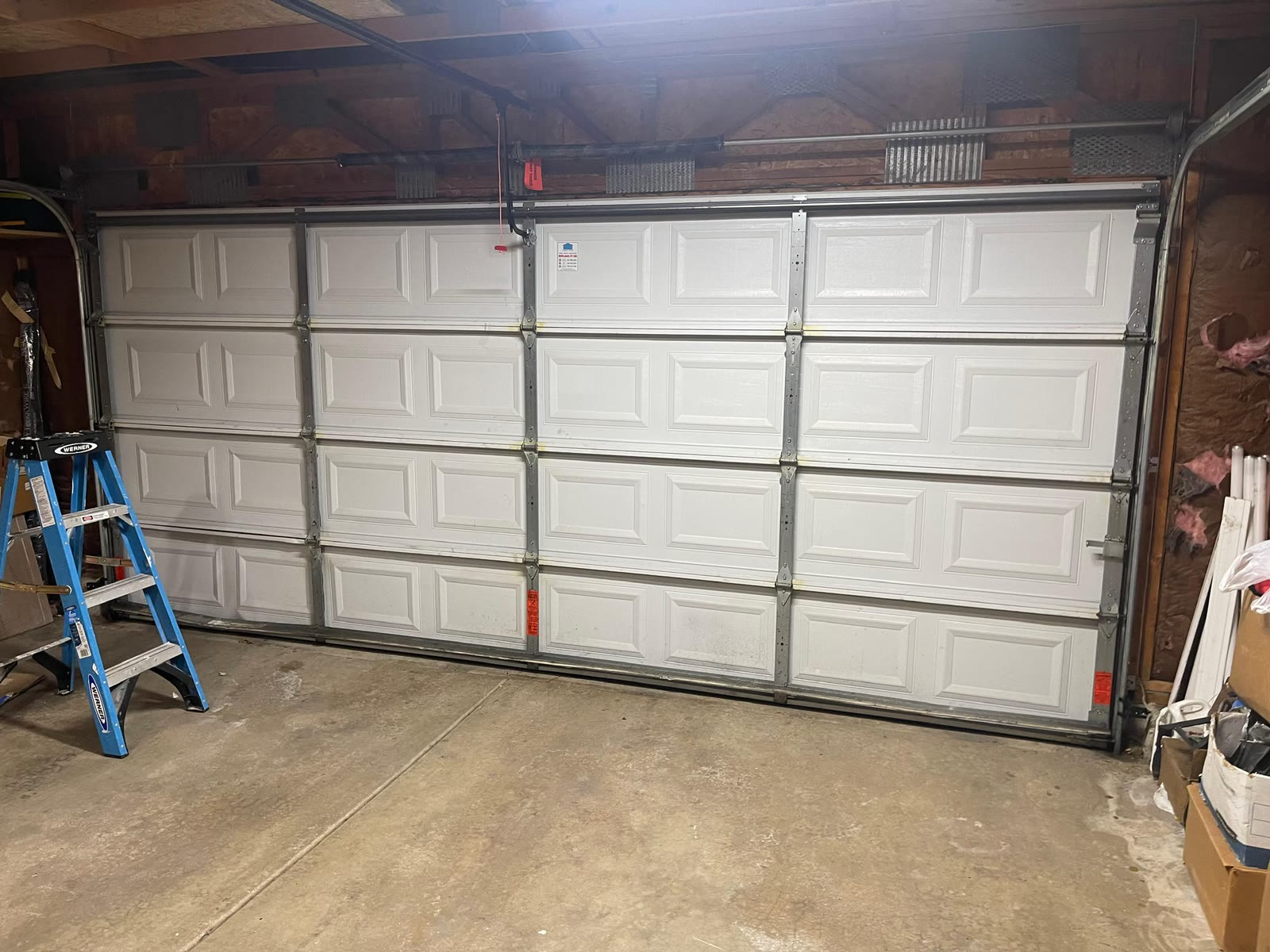
A jackshaft opener has no rail. It bolts to the wall beside the door, next to the torsion shaft, and turns that shaft directly, the same way a person would if they were cranking it by hand. The whole center of the ceiling stays empty.
That matters in two situations. The first is low headroom, meaning there is not enough height between the top of the door and the ceiling for a rail and a trolley. That covers a lot of the 1950s and 1960s garages in Wedgwood and Hurst, and most detached alley garages in older Fort Worth neighborhoods. The second is a shop or a barn where you want the overhead space for storage racks or a lift.
One condition, and it is not negotiable. A jackshaft only works on a torsion system, meaning springs on a steel shaft above the door, and that system has to be in good order first. The unit applies torque straight into the counterbalance instead of pushing a door along a rail. A door running extension springs along the side tracks has to be converted to torsion, which is most of the reason a wall mount install costs more.
The torsion shaft is not a homeowner part
A wall mount unit sits inches from a wound torsion spring. That spring holds enough stored energy to break an arm or take fingers off if a set screw slips or a winding bar gets away, and it holds that energy while the door is closed and sitting still. Do not loosen the drums, unwind the spring, or pull the shaft to make room for an opener. There is no safe way to learn that job on your own door.
Horsepower, DC motors, and what actually changes how it feels
Horsepower gets oversold. A half horsepower motor is not lifting your door, the springs are. The motor pushes and pulls a door the counterbalance has already made close to weightless. Moving up to three quarters or a full horsepower buys margin, which is worth something on a heavy insulated double or a solid wood carriage door. It does not fix a heavy door. If the springs are weak, a bigger motor breaks the next part in line a little later.
- AC motor: the older design. One speed, hard start, hard stop, cheapest to build, and often louder than the chain it is pulling.
- DC motor: variable speed and quieter, and the reason soft start and soft stop exist at all.
- Soft start and stop: less shock into the door, the arm and the top panel every cycle, and the top panel is the section that cracks first on an aging door.
- Battery backup: a DC unit runs off an onboard battery through an outage and keeps the sensors live. Worth paying for if the garage is the door your family actually uses.
- Smart features: Wi-Fi, an app, a camera, a timer to close. Useful to some people, but a separate decision from the drive.
What actually moves the price
We are not going to invent a number for a unit and an install, because it depends on which parts the door needs. The structure is simple, and there are only a handful of levers.
- Drive type. Chain is the least expensive unit, screw sits above it, belt above that, and a wall mount is the most expensive on the shelf.
- Motor type. A DC motor with soft start and stop costs more than an AC motor and earns it on a door you cycle six times a day.
- Battery backup. Built into the model or not available on it, so it moves you up a model line rather than adding a part.
- Smart features. Built in Wi-Fi and a camera add cost. A retrofit bridge on a sound opener does most of the same job for less.
- Install labor. Hanging the head and rail, running the sensor and wall control wire, setting travel limits and force, programming remotes. Close to the same on any drive.
- Hardware condition. A wall mount costs more partly because the torsion hardware has to be right before the unit goes on it, so worn bearings or tired springs get handled first.
Do this before you buy any opener
Close the door, pull the red release handle, and lift it by hand. A balanced door takes around ten pounds of effort and stays put when you let go at waist height. If it slides down the springs are weak. If it shoots up there is too much tension. Fix the counterbalance before you spend anything on a motor, because every opener here is built to steer a nearly weightless door, not carry one.
Need this done?
We handle opener repair & installation across Fort Worth and the western metroplex. Call (214) 831-2545 or book online.
Questions
Common questions
Is a belt drive worth the extra money over a chain drive?
It depends entirely on who is on the other side of the wall. If a bedroom, a home office or a nursery sits above or beside the garage, yes, and the difference is obvious the first night. If the garage is detached or sits off the far end of the house, the chain does the same work for less and you will not notice the noise.
Will a bigger motor fix a door that struggles to open?
No. A struggling door is almost always a counterbalance problem, meaning weak or broken springs, or something binding in the track. A bigger motor muscles through it for a while and then strips its gear or bends the door arm, because you added force instead of removing resistance. Do the hand balance test first.
Can I put a wall mount opener on any garage door?
Only on a torsion spring door, meaning springs on a shaft above the opening, and only when that hardware is sound. A door on extension springs along the side tracks has to be converted to torsion first. Check side room too, because the unit needs wall space beside the door to mount.
Do screw drive openers really need a special grease?
Yes, and skipping it is why most of them fail early. The rod takes a low temperature synthetic grease sold for that purpose, not spray lubricant and not standard white lithium. Wipe the old grease off the thread, apply the correct one along the full length, and run the door a few cycles to spread it.
How long should a new opener last?
Ten to fifteen years in a normal household. The drive gear and the capacitor are the parts most likely to want attention before then. The one thing that shortens that life more than anything else is door balance, because an opener covering for tired springs does far more work per cycle than it was designed for.
More advice
Keep reading
Garage Door Will Not Close: The Checklist, In Order
A door that goes down and comes right back up has about a dozen possible causes, and they are not equally likely. Run them in this order and most people never reach the expensive end of the list.
OpenersWhy Garage Door Openers Die Early In North Texas
An opener that quits is usually the second thing that broke, not the first. Here is the force path, the heat and surge damage specific to our summers, and the honest line between repair and replace.
OpenersSmart Garage Door Openers, Worth It Or Not
The honest case for a smart opener is short: knowing whether you left it open, letting somebody in without a key, and closing it from work. Everything else on the box is a feature list.