Openers
Why Garage Door Openers Die Early In North Texas
An opener that quits is usually the second thing that broke, not the first. Here is the force path, the heat and surge damage specific to our summers, and the honest line between repair and replace.
The short version
- An opener that quits is usually the second thing that broke, because springs losing tension force the motor, gear, trolley and door arm to carry weight they were never sized for.
- The failure order is predictable: nylon drive gear, then trolley, then the curved door arm, then the top panel where the arm bolts on.
- Ceiling heat ages capacitors and control boards, and storm surges kill boards outright, which a plug in surge protector on the opener outlet largely prevents.
- Repair usually wins under about fifteen years with parts available, and replacement makes sense when there are no photo eyes, the board is discontinued, or the motor failed on an already old unit.
Most garage door openers do not die of old age. They die because the door got heavy and nobody noticed.
Springs do not fail all at once. They lose tension gradually over thousands of cycles, and the door gets heavier by an amount too small to feel when all you do is press a button. The opener feels it. It is the only thing in the garage that can make up the difference, and it does on every cycle until something gives out. By the time an opener quits, it has usually been overloaded for a year.
The force path, and why it fails in a fixed order
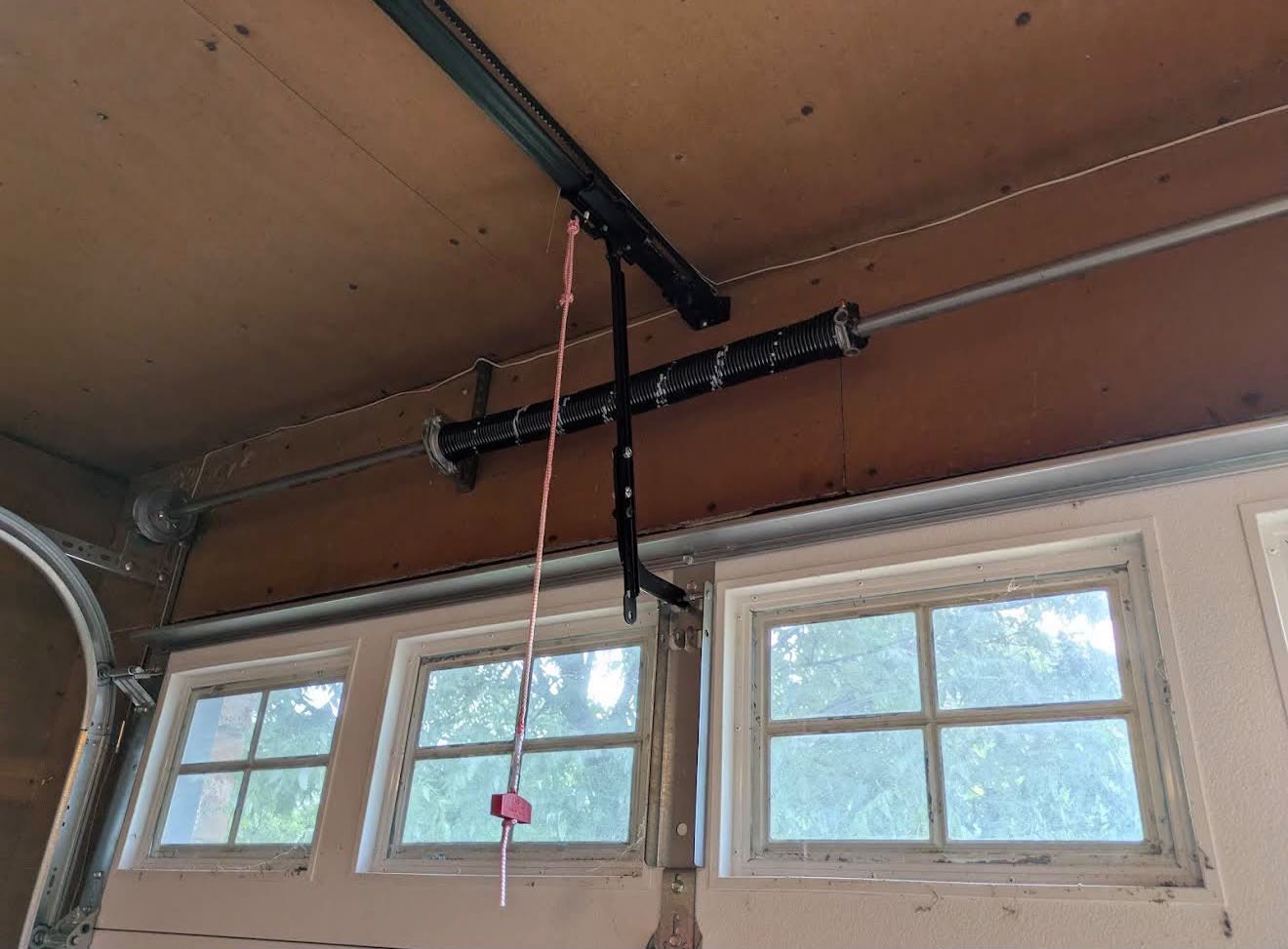
Trace the load and the failure order stops being a mystery. The motor turns a nylon worm gear. The gear drives the chain or belt. The chain pulls a trolley. The trolley pulls a curved steel arm. The arm bolts to a bracket on the top panel. Every pound the springs stopped carrying travels that path, and it breaks the weakest link first.
- Nylon drive gear. Plastic by design, so it fails before the steel does. Symptom: the motor runs the full cycle and the door never moves.
- Trolley. The plastic carriage cracks or the release mechanism wears out. Symptom: the chain moves and the door does not.
- Curved door arm. It bends, and you can usually see it. Symptom: the door lurches at the start of travel.
- Top panel. The opener bracket tears out of the steel skin around its bolts. Symptom: a bulge or torn metal at the top section. That is door repair, not opener repair.
That order is why a technician looks at the door before touching the opener. A stripped gear on a door that balances by hand is normal wear. A stripped gear on a door that drops when you let go is the second symptom of a spring problem, and replacing only the gear means doing it again in a few months.
The ten second test, before you spend anything
Close the door. Pull the red handle to disconnect the opener. Lift the door to waist height and let go. It should take around ten pounds of effort and stay where you put it. If it slides down, the springs are weak and the opener has been covering for them. If it shoots up, there is too much tension. If it grabs at one spot, that is a roller or a track. It costs nothing and tells you whether you are buying an opener part or a door part.
Do not run that test on a door that already banged
If you heard a loud bang and the door is now much heavier, a spring is broken and the whole weight is hanging on the cables and bottom brackets. That is a couple of hundred pounds with nothing counterbalancing it. Leave the door closed, leave the opener disconnected, and keep vehicles and people out from under it. Springs, cables and bottom brackets stay under load even with the door on the floor, and none of them are homeowner parts.
An attic hot garage cooks the electronics
An uninsulated garage under a west facing roof sits well over a hundred degrees through a summer afternoon, and the motor head is bolted to the ceiling, where the hottest air collects. Two things suffer. Electrolytic capacitors, the small cans on the logic board and the starting capacitor on the motor, are rated for a temperature and a number of hours at it, and heat spends that budget fast. Solder joints and board traces run a full thermal cycle every day.
That is why a five year old opener in a hot detached garage in Azle can behave older than a fifteen year old unit in a conditioned shop. The symptoms sound like gremlins: a hum with no movement, a wall button that works some days, a unit that runs fine in the morning and refuses at four in the afternoon. Heat also shortens battery backup life, and a backup that has been through three of our summers will not deliver the cycles printed on the box.
Storm season takes boards out all at once
The other electrical killer is faster. A storm drops a line somewhere, the utility switches, and the voltage on your circuit spikes for a fraction of a second. An opener control board has essentially no protection against that. Our own job photos include two operator boards with burnt traces and scorched components, visible with nothing more than the cover off.
The symptom is usually total: nothing from the remote, nothing from the wall button, no light, sometimes a breaker that will not stay reset. Sometimes it is partial, where the motor still runs but the radio receiver is dead, so the wall button works and no remote does.
A surge protector on the opener outlet is cheap insurance
The opener hangs off a dedicated ceiling outlet with nothing else plugged into it. A plug in surge protector on that outlet costs a small fraction of a control board and takes one minute on a ladder. If you have a battery backup, plug it in through the protector too. It will not stop a direct strike, and it does stop the routine grid transients behind most of the fried boards we pull down.
Dust and grit, a real problem west of the county line
Out in Parker and Wise County the garages take different abuse. Gravel drives, open pasture and steady wind put fine grit in the air. It packs into roller bearings, which are unsealed on builder grade rollers, and turns a rolling roller into a sliding one. It coats the rail so the chain drags. It films the sensor lenses. And it gets in through the vents onto the board, where it holds heat and traps moisture.
This is one of the few problems you can fix with a rag and a vacuum. Wipe the rail, wipe both sensor lenses, and vacuum the vents on the motor head once a year. Lubricate hinges, rollers and springs with a product made for garage doors. Do not grease the track, because a track is a guide surface rather than a bearing, and grease in there only collects more grit.
The first cold morning of the year
Every fall there is a wave of calls on the first cold morning, and it is one call repeated. The rubber bottom seal stiffens overnight. It rests on a cold slab, sometimes stuck to it by a film of moisture. Grease in the hinges and end bearings thickens. The door now needs more force to break loose than it did in October.
The opener has no way to know why. It sees resistance above what its force setting calls normal, decides something is in the way, and reverses. That is the safety system working correctly on a door that got harder to move. The fix is to remove the resistance, not add force: lubricate the moving parts, check the seal for tears or a section stuck to the concrete, then have the force reset to the lowest number that runs the door.
Two small things that get blamed on a dying opener
First, the light bulb. Many LED bulbs throw radio noise across the frequencies the opener receiver listens on, and the antenna sits a few inches away in the same housing. The result is a remote that works on the driveway apron and not from the street, which reads as a failing receiver. Swap in a bulb rated for garage door openers before replacing anything. Second, the antenna wire hanging off the motor head has to hang straight down and free. Tucked up over the housing it loses most of its range.
Repair or replace, said plainly
Repair usually wins under about fifteen years old when the part is still available. Drive gears, capacitors, trolleys, arms, sensors, wall controls and remotes are all normal parts, and a gear kit installed costs a fraction of a new opener installed.
Replace in three cases. One, the unit is old enough that it has no photo eyes at all, meaning no sensors near the floor, because no part you can add gives that opener a real safety reverse. Two, the board failed and it is discontinued or costs half a new opener. Three, the motor or gearbox went on a unit already past fifteen years, where the capacitor, trolley and rail are at the same point in their lives.
Everything outside those three is a repair, and the balance test still comes first.
Need this done?
We handle opener repair & installation across Fort Worth and the western metroplex. Call (214) 831-2545 or book online.
Questions
Common questions
The motor runs but the door does not move. Is the opener dead?
Almost certainly not. That symptom is the nylon drive gear stripping inside the motor head, which is a normal wear part and a normal repair. It can also be a snapped chain or belt, or a trolley left disconnected after somebody pulled the red handle. Check the trolley first, because reconnecting it is free.
How does a heavy door actually kill an opener?
The springs are supposed to counterbalance the door so it weighs almost nothing to move. As they lose tension, the difference gets carried by the motor, the drive gear, the trolley and the door arm on every cycle. Those parts are sized for steering a balanced door, not lifting a heavy one, so they wear out years early and in a predictable order.
Is it worth putting a surge protector on the opener?
Yes, and it is one of the cheapest things you can do for it. Boards fried by grid surges are a routine call after storm season, and a plug in protector on the ceiling outlet costs a small fraction of a replacement board. It is not protection against a direct lightning strike, which nothing at that price is.
My door reverses on cold mornings and works fine by lunch. What is that?
A hardened bottom seal on a cold slab, plus thickened grease in the hinges and bearings. The door takes more force to break loose, and the opener reads the extra resistance as an obstruction. Lubricate the moving parts and check the seal. Do not cure it by turning the close force up, because that setting is what stops the door on an obstruction.
When does replacing the opener beat repairing it?
When there are no photo eye sensors at the floor at all, when the control board is discontinued or costs half a new unit, or when the motor itself failed on a unit already past fifteen years. Under that, with parts available, repair almost always wins on money. Either way, check door balance first so the new unit is not inheriting the same overload.
Does garage heat really shorten an opener's life?
Yes, mostly through the electronics rather than the mechanics. Capacitors and boards are rated for hours at temperature, and a ceiling mounted head in an uninsulated garage spends its afternoons at the hottest point in the room. It shows up as intermittent faults, resets, and battery backups that stop holding a useful charge.
More advice
Keep reading
Garage Door Will Not Close: The Checklist, In Order
A door that goes down and comes right back up has about a dozen possible causes, and they are not equally likely. Run them in this order and most people never reach the expensive end of the list.
OpenersChain, Belt, Screw And Wall Mount Openers Compared
Belt if somebody sleeps near the garage, chain if nobody does, wall mount if the ceiling is low. Here is the mechanism behind each one and the part you will eventually pay to replace.
OpenersSmart Garage Door Openers, Worth It Or Not
The honest case for a smart opener is short: knowing whether you left it open, letting somebody in without a key, and closing it from work. Everything else on the box is a feature list.