Safety
Garage Door Safety When There Are Kids In The House
Break the photo eye beam with a broom handle, then close the door onto a two by four. Five minutes, no tools, and it tells you whether both of your door's safety systems still work.
The short version
- The photo eye test and the two by four test check two independent safety systems and take five minutes together.
- Federal rules since 1993 require external entrapment protection, which is why photo eyes sit within six inches of the floor.
- Turning up the close force removes the contact protection instead of fixing the balance, seal, or limit that caused the reversal.
- The wall control belongs at least five feet up, and the red release cord should only be pulled with the door fully closed.
Two tests, five minutes, tonight, no tools and no cost. First, start the door closing and break the beam between the two photo eyes near the floor with a broom handle. The door should stop and reverse immediately, before it touches anything. Second, lay a two by four flat on the floor in the door's path and close the door onto it. The door should hit the wood, stop, and reverse. If it pushes through, hesitates, or sits there pressing down, the door is not safe around a child.
Those two tests check two separate systems, which is the part most people miss. One stops the door before contact. The other stops it after contact. A door needs both, and it is common to find houses where one of them has quietly been switched off.
Test one, step by step: the photo eyes
This checks the non contact system, the one meant to catch a child in the doorway before the door ever reaches them.
- Clear the doorway and put the car outside, then stand to the side of the opening rather than in it
- Press the wall button to start the door closing
- Once it is moving, pass a broom handle through the beam about a foot above the floor, never a hand, a foot, or a child
- The door should stop and reverse the instant the beam breaks, and travel all the way back to fully open
- If it keeps closing, stops without reversing, or reverses only partway, stop using the opener until it is corrected
While you are down there, check that both eye brackets sit within six inches of the floor and that both indicator lights are steady rather than blinking. Eyes knocked out of alignment by a bike or a trash can are the most common cause of a door that will not close, and straightening the bracket by hand is a fair do it yourself job.
Test two, step by step: the two by four on the floor
This checks the contact system, the force reversal built into the opener. It is the backstop for anything the eyes miss, including an object low enough to sit under the beam.
- Lay a two by four flat on the concrete, wide face down, roughly centered under the door
- Press the button to close and stand well clear of the door
- The door should contact the wood, stop, and reverse back to open within about two seconds
- If it pushes down on the wood, grinds against it, or stalls and sits there, the door fails and should not be used until it is corrected
Flat side down matters, because it gives an obstruction about an inch and a half tall, which is the standard rough check. Know too that a door can fail this test with correct force settings. An unbalanced door, a hardened bottom seal, or a close limit set past the floor all make the opener push harder at the bottom of travel. The fix then is balance and limits, not force.
Why two independent systems are required, not one
Since 1993, residential garage door openers sold in this country have had to include an external entrapment protection system in addition to the opener's own force reversal. In practice that means photo eyes, mounted no higher than six inches above the floor. Six inches is not arbitrary. It is low enough to catch a child lying down, crawling, or reaching under a closing door, which is the case the requirement was written for.
The two systems fail differently, which is why both exist. Photo eyes get misaligned, dirty, sun blinded, or taped together by somebody tired of nuisance reversals. Force reversal gets defeated by turning the setting up. If either one is compromised, the door runs on a single layer of protection and nobody can tell by looking at it.
Why turning up the close force deletes your backstop
The force setting tells the opener how much resistance to accept before deciding it hit something. When a door starts reversing for no obvious reason, the fastest thing anyone can do is turn that setting up, and the reversing stops. That feels like a repair. What it did was raise the threshold so the opener now pushes through whatever it meets, which includes a pet, a bicycle, and a child.
Nuisance reversals almost always have a mechanical cause and a mechanical fix. A bottom seal hardened by cold makes the door land stiffly, and the first cold morning of the year fills the phone with these. A sticky roller grabs at one point in travel. A close limit set past the floor keeps the opener pushing after the door has landed. A shifted slab leaves a wedge of daylight at one end. Find the cause, fix it, and the door closes on the original setting.
A door that fails either test goes out of service until it is fixed
Disconnect the opener with the red release handle, close the door by hand, and use another entrance until the reversal works. Do not turn the force up, and do not tape or bypass the photo eyes to get through a week. Those two systems stand between a closing door and a child on the floor.
Where the wall control goes, and why a remote is not a toy
Mount the wall control at least five feet above the floor. That is high enough that a small child standing in the garage cannot reach it, and it is in the installation instructions of every opener sold. Mount it where the person pressing the button can see the whole door travel, not around a corner. A large share of incidents involving kids come down to one child pressing a button while another is standing where the door is going.
Remotes belong with car keys, not in a toy bin or clipped to a backpack. A remote in a child's hands runs a heavy machine from outside the garage while nobody is watching what is under it. Treat an outside keypad code like a house key and change it when the list of people who need it changes.
Pinch points, and the ones a child finds first
As a sectional door closes, the gap between two adjacent sections closes to nothing along the hinge line. That gap is exactly the size that invites a small hand, and it shuts with the weight of the door behind it. Pinch resistant sections are shaped so the joint pushes a finger out as it closes rather than closing on it, which is why newer doors have that curved profile along the section edges. Older flat panel doors have no such protection.
The sides are the second hazard, where rollers travel in the track and the door edge passes the jamb. One rule covers all of it, short enough for a five year old: nobody stands under a moving door, and nobody touches a door that is moving.
The release cord, riding the door, and teaching a teenager
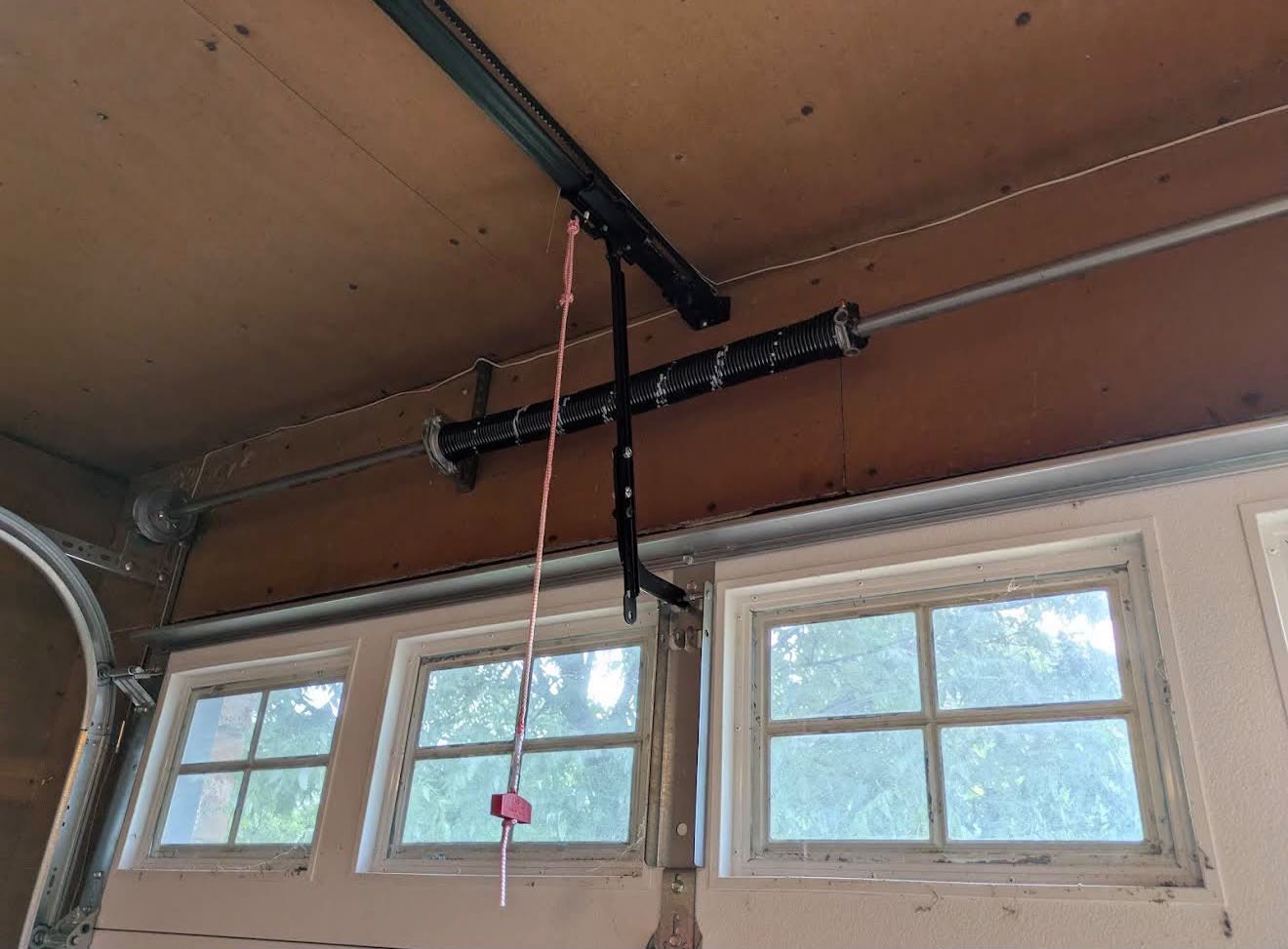
The red cord on the trolley disconnects the door from the opener so it can be moved by hand. It is meant to be pulled with the door fully closed, or fully open and supported. Pulling it part way through travel is dangerous, because if the springs are weak or broken the door drops with nothing holding it. Kids pull that handle because it is a bright red rope at eye level, so tie it up where adults can reach it and children cannot.
Riding a closing door is the other one worth naming plainly. Kids hang on the bottom section as it lifts, and as the door curves into the horizontal track their hands go over the top of the section and into the header gap. There is no version of that with a good ending.
Teach the manual release to any teenager old enough to drive, because it is what gets a car out during a power failure. Do it with the door fully closed. Show them the cord, have them pull it, have them lift the door by hand and feel that a balanced door takes about ten pounds and stays where they leave it. Then show them how to re engage, which is usually running the opener until the trolley clicks back onto the carriage.
Run both tests every six months, and they cost nothing
Put them on the same schedule as smoke detector batteries, spring and fall. The photo eye test and the two by four test together take about five minutes and need no tools. Nothing about this requires a technician, and nothing about it costs money.
Need this done?
We handle garage door maintenance & tune-up across Fort Worth and the western metroplex. Call (214) 831-2545 or book online.
Questions
Common questions
How often should I test the auto reverse?
Twice a year is the practical answer, on the same schedule as smoke detector batteries. Run both tests, since the photo eyes and the force reversal are separate systems that fail independently. Retest after any repair, after a power surge, or if anyone has adjusted the opener settings.
My door reverses for no reason and I was told to turn up the force. Is that safe?
No. Turning up the close force raises the resistance the opener will push through before reversing, which is the same protection meant to stop the door on a child or a pet. Nuisance reversals normally come from a hardened bottom seal, a sticky roller, a close limit set too far, or springs losing tension. Each of those has a real fix.
Why do the photo eyes have to be so close to the floor?
Because the hazard the rule was written for is a small child lying, crawling, or reaching under a closing door. Federal requirements since 1993 call for external entrapment protection on residential openers, and photo eyes within six inches of the floor is how nearly every manufacturer meets it. Eyes mounted higher leave a gap a child fits under.
Is it safe for my kids to press the wall button?
Only if they can see the entire door and nobody is standing in the opening. The wall control should be mounted at least five feet up so a small child cannot reach it, and positioned where the whole door is visible. Most incidents involving children come from one child pressing a button while another is under the door.
My door has flat sections with a gap between them. Is that a problem?
It is a pinch point, and it is why newer doors use pinch resistant section profiles that push a finger out of the joint as the door closes. On an older flat panel door you cannot add that protection, so the rule has to come from the household: no hands on a moving door and nobody standing under it. It is also worth weighing when the door eventually gets replaced.
Should I show my teenager the emergency release?
Yes, and do it with the door fully closed. Have them pull the cord, lift the door by hand, and feel that a balanced door takes about ten pounds of effort and stays where they let go. Then show them how the trolley re engages. Never pull the release while the door is part way up, because a weak or broken spring means the door drops.
More advice
Keep reading
Photo Eye Sensors: What The Blinking Light Means And How To Fix It
Photo eyes are the most misunderstood part on a garage door and the easiest one to fix yourself. Here is how the pair works, what the blinking light means, and the one finding that gets reported before anything else.
MaintenanceWhat A $79 To $99 Tune-Up Actually Covers
A tune-up is the easiest service in this trade to sell as a vague good deed. Here is exactly what $79 to $99 changes on your door, and who does not need one at all.
Buying GuideWhat Not To Overpay For On A Garage Door Repair
Openers replaced over a stripped gear, whole doors sold over one dented panel, new track that only needed adjusting. Here is the item by item breakdown, including the upgrades that really are worth the money.