Maintenance
The Garage Door Maintenance You Can Do Yourself, And The One Thing You Cannot
Most of a maintenance visit is a rag, a socket set and the right can of lubricant. Here is the whole routine in order, and the one part of it that puts people in the emergency room.
The short version
- Four fifths of a maintenance visit is homeowner work: lubricating, wiping the track dry, tightening bolts, and testing both safety systems.
- A penetrating spray is a cleaner, not a lubricant, and it leaves a bearing drier than it was before you sprayed it.
- The track gets wiped and never greased, because grease makes the roller slide, flat spots the wheel, and combines with dust into grinding paste.
- Spring tension is never homeowner work, and that includes winding cones, drum set screws and bottom brackets.
Most of what happens on a maintenance visit is work you can do yourself. That is not a strange thing for a garage door company to say. A tune-up is a rag, a socket set, a can of the right lubricant and about forty minutes, and roughly four fifths of it is within reach of anyone who owns a 7/16 socket.
There is one part you cannot do, and that is not a judgment about your ability. It is spring tension, and the reason is physics rather than skill. Everything else is yours. Here it is in the order we would do it.
Buy the right can, and know the one that is not a lubricant
White lithium grease spray or a synthetic lubricant sold for garage doors. Both cling to a vertical surface and stay on a spring coil. That is the whole requirement, and the house brand is fine.
What you do not want is a penetrating spray, and this is the mistake almost everyone makes because that can is already on the shelf. It is a solvent built to creep into a rusted fastener and displace water. Sprayed on a bearing it dissolves the grease still in there, carries it out, and evaporates. The part is quieter for a week and then louder than before, because now it is dry. It is a cleaner, not a lubricant. Skip motor oil too, and put nothing at all on the track.
Lubricate these parts, in this order
Do it with the door closed so the spring is fully wound, then run the door once to distribute it. Ten minutes.
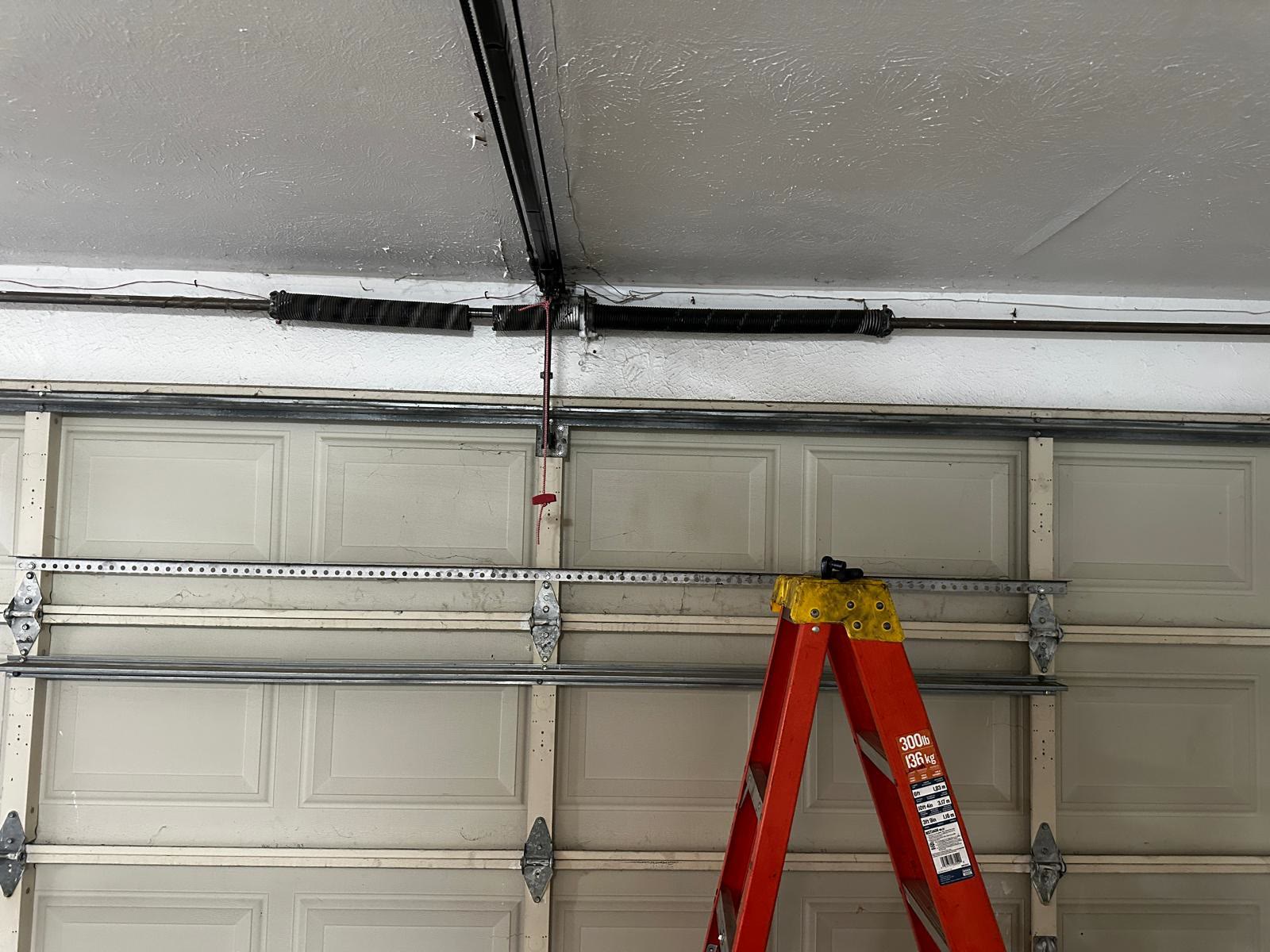
- Torsion spring coils. A light pass along the whole spring. Coil rubbing on coil is what makes an old spring squeal and it wears the steel where fatigue cracks start.
- End bearings. At each end of the shaft a bearing plate is bolted to the header. Hit the bearing where the shaft passes through.
- Center bearing, in the middle bracket where the spring anchors. This one gets skipped constantly and it is a common source of a low groan.
- Hinge pivots. One short squirt where the two leaves meet. A double door has fourteen to twenty of them.
- Roller stems, right where the stem enters the hinge sleeve. Sealed nylon rollers have a closed wheel bearing that needs nothing, but the stem still does.
- The opener rail, if it is chain or screw drive. A thin coat where the trolley rides.
- Wipe off the excess. A wet part collects dust and turns into paste.
Wipe the track. Never grease it.
The track is not a bearing surface. The roller is supposed to roll on it. Grease makes the roller slide instead, which flat spots one side of the wheel and gives you a thump once per revolution forever. It also holds dust, and around here that means fine limestone and caliche off gravel drives, and the mix works like valve grinding paste that eats the roller stem. The correct maintenance is a dry rag down the inside of both vertical tracks and as far up the horizontals as you can reach. If somebody already greased them, use a little household degreaser and dry the track completely.
Tighten what vibration walked loose
A door that opens four times a day runs about fourteen hundred cycles a year, and every one shakes every fastener on it. Bolts back out. This is the highest value ten minutes in the routine. Work bottom to top: both bolts on every hinge, the lag bolts in the vertical track brackets, the bolts at the ceiling hangers, the bearing plate bolts at each end of the header, and the opener header bracket. Snug is the target, because overtightening into thin sheet steel strips the hole.
Watch for the hole that has gone oval. Put the wrench on and feel for the bolt to firm up. If it never gets tight, or the hole is longer than it is wide, the steel has stretched and that fastener will never hold again. That hinge or bracket needs replacing, not tightening. It is a cheap part and it will not fix itself.
The ten second balance test, and what each answer means
Close the door all the way. Pull the red release handle with the door closed and flat on the floor, never part way up. Lift the door by hand and let go around waist height.
- It takes about ten pounds and stays where you leave it. That is a balanced door. Nothing to do.
- It drifts down or drops when you let go. The springs have lost tension, and the opener has been carrying that difference on every cycle.
- It runs away from you and slams open. Too much tension, which is just as hard on the hardware.
- It grabs at the same point every time. Not a spring problem. That is a roller, a hinge, or a spot in the track.
- It is heavy from the first inch. Set it down and look at the spring for a gap. A broken spring means you are holding the whole door.
Reconnect by pulling the handle back toward the door, or by running the opener until the trolley clicks onto the carriage. If the answer was anything but the first one, write it down. It is the most useful sentence you can hand to whoever works on the door.
The safety checks, and the flashlight pass
Two separate systems stop a closing door and both are testable in five minutes. Start with the photo eyes, two small units on the vertical track within six inches of the floor, which is where a child crawling under the door breaks the beam. Wipe both lenses dry, because dust and spider webbing are the top cause of a door that will not close. On most brands one indicator is steady and the other blinks when it is out of alignment, so loosen the wing nut, aim until the blinking stops, and retighten. Then close the door and wave a broom handle through the beam. It should stop and travel all the way back up, not stop and sit.
Then the contact reverse, which works independently. Lay a two by four flat in the door path and close the door. It should reverse within about two seconds of contact. A roll of paper towels is not a test, because it crushes. If either test fails, stop using the opener for anything except getting the cars out.
While the flashlight is out
Check the cables where they wrap the drum and where they loop through the bottom bracket, looking for a fuzzy halo or one wire standing off the lay. Look, do not touch. Then close the door, kill the garage lights, and check the daylight along the floor. An even sliver is fine. Daylight at one end and none at the other means the slab has moved, which is routine in North Texas clay. A new seal fixes a hardened seal. It does not fix a slab.
The one thing you cannot do, and when to stop and call
Spring tension. That is the flat no, and it covers more than it sounds like. No winding bars into a loaded cone. No loosening the set screws on a winding cone. Nothing on the drum set screws at either end of the shaft. And no bottom bracket bolt, on any door, at any time.
Four results from the routine mean the door has passed out of homeowner maintenance. The hand test showed drift, fall or runaway, so the balance is wrong. A spring shows rust pitting or a gap between coils. A cable has fuzz at the drum or the bottom loop. Or either safety test failed, which is the door being unsafe today. Any of those four is worth the $79 to $99 tune-up, because all four get corrected in one visit.
Two passes a year, timed to North Texas
Do the routine twice. The first at the end of summer, because months of garage temperatures well over a hundred degrees drive the grease out of the bearings and off the spring coils. The second before the first hard freeze, because cold steel is stiffer and a marginal door picks the first cold morning to fail. If you only ever do one, do the end of summer pass.
Spring tension is the line and it does not move
Never wind, unwind, adjust or remove a torsion spring, and never loosen a bottom bracket or a drum set screw. On a closed door each of those holds the full stored energy of the spring, which is what lifts a two hundred pound door. Releasing it by hand releases all of it at once. Winding bars kicking loose under load break hands and jaws. There is no careful way to attempt this one.
Need this done?
We handle garage door maintenance & tune-up across Fort Worth and the western metroplex. Call (214) 831-2545 or book online.
Questions
Common questions
How often should I actually do this?
Twice a year covers almost every door, once at the end of summer and once before the first freeze. If your garage opens onto a gravel or caliche drive, or the door faces west and bakes all afternoon, add a track wipe in between. If the garage is the family front door and runs six times a day, treat twice a year as the minimum.
What lubricant should I buy?
White lithium grease spray or a synthetic lubricant sold specifically for garage doors. Both cling to a spring coil instead of running off it. Do not use a penetrating spray as a lubricant, because it is a solvent that strips the grease out of a bearing and leaves the part drier than it started.
Why can I not lubricate the track when it squeaks?
Because the noise is not coming from the track surface. It is coming from a roller stem or a dry bearing. Grease in the track makes the roller slide instead of roll, which flat spots the wheel, and it holds dust until the mix becomes grinding paste. Clean the track dry and lubricate the stem instead.
Can I replace my own rollers?
The middle ones, carefully, on a door in good condition, by flexing the section enough to bring the stem out of the track. The bottom rollers are different, because they sit in the bottom bracket and that bracket is under full spring tension on a closed door. If the goal is quieting the door, it is worth having the whole set done so the bottoms get handled properly.
Does any of this make the springs last longer?
Somewhat, but not the way people hope. A spring is rated for a number of cycles and it spends them whether it is greased or not. What lubrication and correct balance prevent are the things that end a spring early: coil on coil friction, rust pitting where cracks start, and running outside the tension range it was sized for.
When should I stop and book a tune-up?
When the hand balance test fails, when a spring shows rust pits or a gap between coils, when a cable has any fuzz at the drum or bottom bracket, or when either safety test does not pass. Those are all spring or safety work, and the first three are the failures that leave a car stuck in the garage.
More advice
Keep reading
What A $79 To $99 Tune-Up Actually Covers
A tune-up is the easiest service in this trade to sell as a vague good deed. Here is exactly what $79 to $99 changes on your door, and who does not need one at all.
MaintenanceHow To Quiet A Loud Garage Door, From Cheapest Fix To Last Resort
Different noises come from different parts. Match the sound to the cause and most loud doors get quiet for the price of a can of lubricant instead of a new opener.
OpenersGarage Door Will Not Close: The Checklist, In Order
A door that goes down and comes right back up has about a dozen possible causes, and they are not equally likely. Run them in this order and most people never reach the expensive end of the list.