Maintenance
How To Quiet A Loud Garage Door, From Cheapest Fix To Last Resort
Different noises come from different parts. Match the sound to the cause and most loud doors get quiet for the price of a can of lubricant instead of a new opener.
The short version
- Each noise points at a part: squeal is dry springs or bearings, rattle is loose bolts, grinding at one spot is a worn roller, and a house rumble is vibration in the ceiling framing.
- Sealed nylon rollers are the single largest noise reduction per dollar on a garage door.
- A rumble heard inside the house is structural, so the fix is a short drop, solid angle iron and rubber isolation pads, not a quieter motor.
- A new opener does nothing about a noisy door, so lubrication, tightening, rollers, hinges and balance all come first.
A loud garage door is telling you something specific. The catch is that different noises come from different parts, and if you match the sound to the part first, most doors get quiet for the price of a can of lubricant instead of the price of a new opener.
Here is the noise list, then the fixes cheapest to last resort. The last resort is a new opener, and it is last for a reason worth reading before spending anything.
Match the sound to the part
Stand in the garage and run the door twice. Where in the travel it happens matters as much as what it sounds like.
- A squeal or groan on the way up, worst in the first couple of feet. Dry spring coils rubbing on each other, or dry bearings at the ends of the shaft.
- A rattle running through the whole travel. Loose hinge bolts and loose track brackets.
- Grinding or scraping at the same spot every cycle. A worn or flat spotted roller, or debris packed in the track at that point.
- A single pop or bang at one place in travel. A hinge or a section flexing around the curve, or a roller jumping in a worn piece of track.
- Slapping and clattering from the ceiling. A loose chain hitting the opener rail on start and stop.
- A rumbling roar heard inside the house more than in the garage. Vibration traveling through the rail hangers into the ceiling framing.
- A deep groan that was not there a year ago. Usually the door going out of balance, and not a lubrication problem.
Start with lubricant, because it fixes about half the list
White lithium grease spray or a synthetic garage door lubricant. Door closed, light pass along the spring coils, the bearings at both ends of the shaft and the center bearing, a squirt in every hinge pivot, and the roller stems. Wipe off the excess. Ten minutes, and it eliminates squeal, groan and most of the noise floor.
Two things not to do. Do not use a penetrating spray, because it is a solvent that strips grease out of the bearing and evaporates, which is why a squeal fixed with that can comes back louder inside a month. And put nothing in the track, because grease makes the roller slide instead of roll and turns garage dust into grinding paste. Wipe the track dry instead.
Tighten everything, which is the free fix for a rattle
A door cycling four times a day runs about fourteen hundred cycles a year and every one shakes the hardware. A rattle is bolts that backed out.
Work bottom to top with a 7/16 socket: both bolts on every hinge, the lag bolts in the vertical track brackets, the bolts at the ceiling hangers, the bearing plate bolts at each end of the header, and the opener header bracket. Snug, not maximum. If a bolt turns and never firms up, that part gets replaced rather than tightened.
Nylon rollers are the biggest quiet down for the money
If you only do one paid thing to a loud door, do this one. A full set of sealed nylon rollers is the single largest noise reduction per dollar available on a garage door.
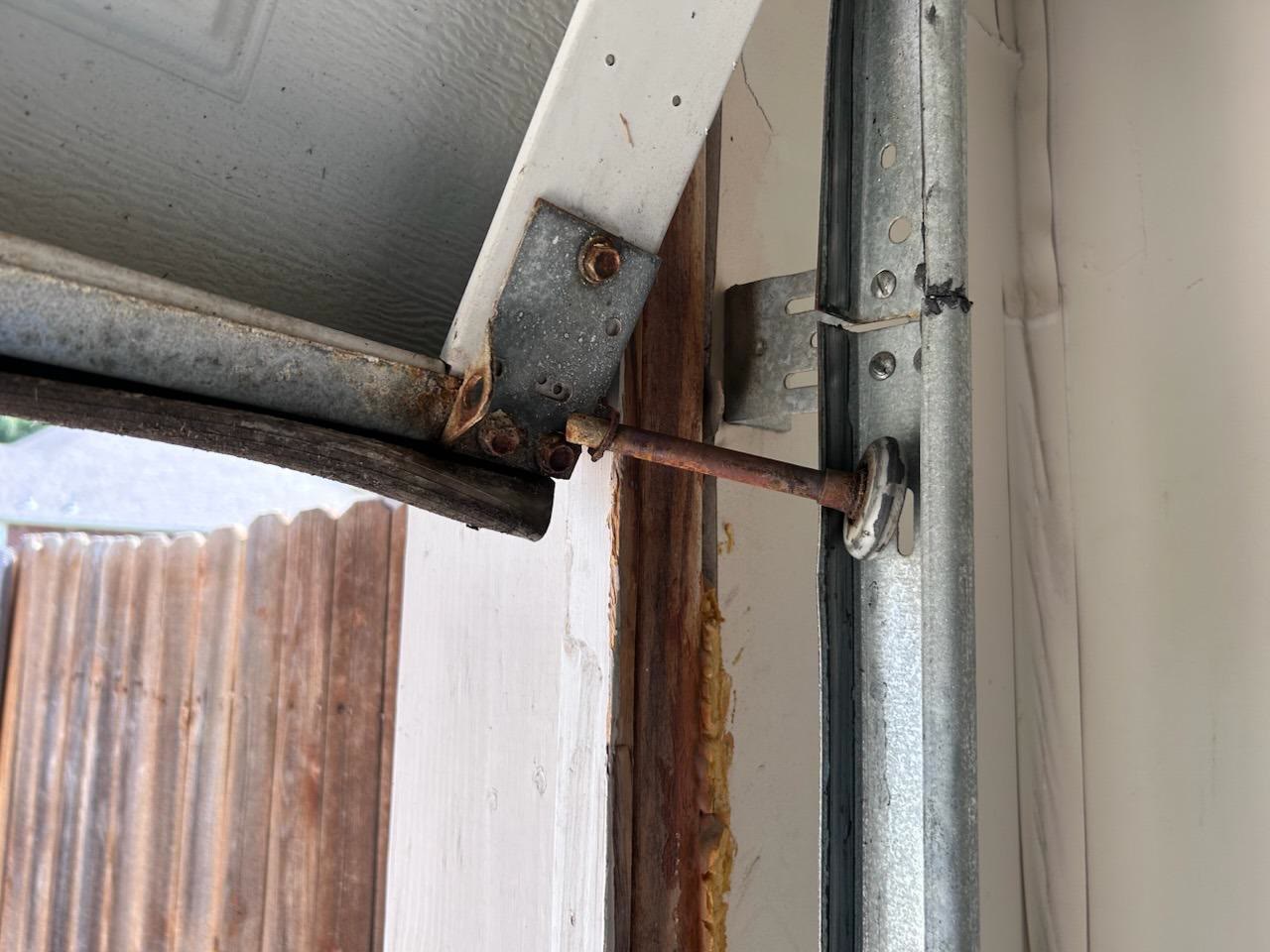
Builder grade doors ship with steel rollers on an open ball bearing, and the cheapest have no bearing at all. Steel wheel on steel track is loud by itself, and the open bearing collects garage dust for ten years until the grease is gone and the grit is in. Then the wheel skids instead of rolling. Sealed nylon rollers have a closed bearing dust cannot reach and a plastic tire that meets the track softly.
A double door takes ten to twelve rollers plus two at the top. The middle ones can be changed by flexing the section to bring the stem out of the track. The bottom rollers cannot, because they sit in the bottom bracket, which is under full spring tension whenever the door is closed. One honest limit: nylon rollers do not fix a bent track, worn hinges or a door out of balance.
Worn hinges, worn track, and the bang at the same spot
A pop or bang at exactly the same point every cycle is geometry, not lubrication. The usual cause is a worn hinge. The bolt holes stretch into ovals over years of cycles, the section drops against the one below it, and the roller stem cocks slightly in the track. As that joint goes around the curve it binds and then releases, and that is the bang. Hinges are inexpensive and replacing them fixes it.
Second cause is the curved track, which takes the most abuse on the assembly. A curve that has been hit, or worn where a flat spotted roller skidded through it for years, lets a roller jump, and you can usually see a polished patch or a dent in the channel. A worn curve gets replaced, not straightened. Third cause is the cheapest to check: debris in the track, which on a shop door in Parker or Wise County is usually caked caliche dust.
Where the noise gets into the house: hangers and chain tension
If the complaint is a rumble heard inside the house rather than a noise in the garage, the door is not louder. The sound is taking a shortcut into the structure. The opener rail hangs from the ceiling framing, usually on thin perforated angle strap, which is the wrong material. It flexes and feeds vibration straight into the joists, and the joists radiate it into the drywall of the room above.
Three fixes, in order. Shorten the drop so the hanger is as short as headroom allows. Replace perforated strap with solid angle iron, which does not act like a tuning fork. Put a rubber isolation pad between the opener head and its hanger bracket. Then chain tension: the spec is usually around a quarter inch of sag above the base of the rail at the midpoint on a seven foot door, adjusted at the turnbuckle on the trolley. Do not overcorrect, because a chain pulled drum tight loads the sprocket and trades a slap for a whine.
Balance, then the last resort
Before spending anything on an opener, do the hand test. Close the door, pull the red release handle with the door flat on the floor, lift by hand and let go at waist height. A balanced door takes about ten pounds and holds where you leave it. A door that drifts, drops or runs away is out of balance, and that is what a new deep groan usually means. Correcting it is spring work, not a homeowner job, but the answer tells you whether an opener would help. It would not.
Now the opener. A chain drive is steel chain over a steel sprocket and there is a limit to how quiet that gets. A belt drive replaces the chain with a reinforced rubber belt, removing the metal on metal contact at the same power. A wall mount jackshaft goes further: the motor bolts to the wall beside the torsion shaft and drives it directly, so there is no rail, no trolley, no chain and no ceiling hanger left overhead to transmit into the framing.
The honest part: a new opener does nothing about a noisy door. If your spring coils are dry, your rollers are worn and your hinges have gone oval, a belt drive will move all of that quietly for three feet and then you will hear the same door. Fix the door first, then decide whether the opener is still the loudest thing in the room.
The bedroom over the garage problem
Newer subdivisions on this side of the metroplex put bedrooms directly over the garage, and it shows up constantly in the Alliance corridor and the Mansfield, Crowley and Aledo build-outs. In those houses the complaint is never how loud the door is in the garage. It is the rumble through the floor at six in the morning. That is structural transmission and lubricant does not touch it. The order that works is hangers first, then nylon rollers, then a belt drive or wall mount unit.
A door that got louder over one year is telling you something mechanical
Noise that grows is wear that is progressing, and lubricant only masks it. A door that has developed a deep groan, a new bang at the same point, or a shudder on the way up over the course of a year is usually doing one of three things: a spring losing tension, a cable starting to fray at the drum, or a roller stem worn to visible play. All three end with the door failing while it is moving. Do the hand balance test. If the door drifts, drops or runs away, stop treating this as a noise complaint.
Need this done?
We handle garage door maintenance & tune-up across Fort Worth and the western metroplex. Call (214) 831-2545 or book online.
Questions
Common questions
What is the single most effective thing for a noisy door?
Lubricating the spring coils, bearings, hinge pivots and roller stems is the most effective free thing, and it fixes squeal and groan outright. Replacing worn steel rollers with sealed nylon rollers is the most effective paid thing by a wide margin, because it removes both the steel on steel contact and the dust filled open bearing causing the skidding.
Are nylon rollers really that much quieter?
Yes, and the reason is mechanical rather than marketing. A sealed nylon roller has a closed bearing garage dust cannot get into and a plastic tire that contacts the steel track softly. A builder grade steel roller has an open bearing that fills with grit and a steel wheel that eventually skids instead of rolls. On a door with otherwise sound hardware the difference shows up on the first cycle.
Why does my door get loud again a month after I spray it?
Almost always because the can was a penetrating spray rather than a lubricant. That product is a solvent built to clean and displace, so it strips whatever grease was left in the bearing and then evaporates, leaving the part drier than before. Use white lithium grease or a synthetic garage door lubricant and the quiet lasts a season.
Will a new opener fix my loud garage door?
Only if the opener is the loud part, and usually it is not. A belt drive or wall mount unit removes chain noise and rail vibration, which is real, but it does nothing about dry springs, worn rollers, oval hinges or a door out of balance. Fix the door first and then judge the opener, because doing it the other way around often means buying an opener and keeping the noise.
The noise is worse in the room above the garage than in the garage.
That is vibration traveling through the rail hangers into the ceiling framing rather than sound through the air. Start with the hangers: shorten the drop, swap thin perforated strap for solid angle iron, and add rubber isolation pads at the opener head and the header bracket. If that is not enough, a wall mount jackshaft removes the overhead rail entirely.
Is a loud door dangerous or just annoying?
It depends on whether the noise is steady or growing. A door that has always been a little loud and has not changed is usually just dry. A door that has clearly gotten louder over the past year is reporting progressive wear, most often a spring losing tension, a fraying cable or a worn roller stem, and those failures happen while the door is moving.
More advice
Keep reading
The Garage Door Maintenance You Can Do Yourself, And The One Thing You Cannot
Most of a maintenance visit is a rag, a socket set and the right can of lubricant. Here is the whole routine in order, and the one part of it that puts people in the emergency room.
MaintenanceWhat A $79 To $99 Tune-Up Actually Covers
A tune-up is the easiest service in this trade to sell as a vague good deed. Here is exactly what $79 to $99 changes on your door, and who does not need one at all.
Cables & TracksWhat Puts A Garage Door Off Track, And What To Do In The First Minute
A derailed garage door is not resting on anything. It is hanging off whatever is still hooked. What you do in the first minute decides whether this is a roller or a new section.