Buying Guide
Garage Door Insulation, Honestly Explained For A Texas Summer
Whether an insulated door pays depends entirely on what is above the garage and what is beside it. Here is the honest version, including the retrofit kits and what they do to your springs.
The short version
- Insulation clearly pays when there is a room over the garage, a shared wall with conditioned space, a door into the house, or a workshop you use; on a detached parking-only garage it is a comfort purchase.
- Cut polystyrene board lands around R-6 to R-9, and injected polyurethane lands around R-12 to R-18 while bonding both steel skins into one stiff panel.
- R-value is a panel number measured in a lab, so the bottom seal, the jamb weatherstrip, and an uninsulated ceiling decide what you actually feel in the garage.
- A retrofit insulation kit adds weight the springs were never sized for, so the counterbalance has to be re-rated after it goes on.
Insulated or not is the question we get asked most on a new door, and the honest answer depends entirely on what is above the garage and what is beside it. Not on the brochure.
Park a car in there, nothing conditioned on the other side of any wall, and an insulated door buys you comfort during the hours you are actually standing in the garage. That is real, but it is not an energy bill argument and we are not going to sell it as one. Put a bedroom over that garage, or share a wall with one, or have a door straight into the kitchen, or run a workshop you actually use, and the insulated door stops being a preference and becomes the obvious buy.
When insulation pays, and when it is just comfort
Start here, because it settles most of the decision before anyone talks about materials.
- Room over the garage: yes. That garage ceiling is somebody's floor, and an uninsulated door bakes it every afternoon.
- A shared wall with a bedroom, an office, or a living space: yes.
- A door from the garage straight into the kitchen or a hallway: yes, because that door trades air with conditioned space every time it opens.
- A workshop, a gym, or anywhere you spend real hours: yes, on comfort alone.
- Detached garage, cars only, nothing above and nothing beside: this is a comfort purchase. Buy it if you want it, but do not let anyone tell you it pays for itself.
We would rather say that flat than have you work it out on your own two summers from now.
What R-value promises, and what it does not
R-value is resistance to heat flow. Higher number, slower transfer. That is the whole definition.
The catch is that the number on the sticker is a panel number. It describes a piece of door measured in a lab, usually at the thickest part of the section. Your garage is not a lab. Air moves around a door at the bottom seal, at the jambs, at the header, and between sections on a door that has racked out of square. A high R panel with a hardened bottom seal and no jamb weatherstrip will lose to a lower R panel that is sealed properly.
The door is also one surface out of several. If the garage ceiling is open joists to a hot attic and the walls are unfinished stud bays, the door is not the biggest leak in the room. That is worth knowing before you spend the difference on a panel, and it is the kind of thing we would rather point at on site than quietly let you pay for.
Seal the cheap leaks before you upgrade the panel
A new bottom seal sized to your slab and fresh jamb and header weatherstrip cost a fraction of a panel upgrade and they usually do more for a hot garage than the difference between two R numbers. If your current door is sound, start there and see what you think.
Board versus foam, and why foam does two jobs
There are two ways insulation gets into a steel door and they are not the same product.
Polystyrene board is cut to size and fitted into the back of each panel. Depending on thickness it lands somewhere around R-6 to R-9. It works, it is cheaper, and because it is a piece of board sitting in a cavity, it does not tie the panel together into anything stiffer than it was.
Injected polyurethane foam goes in as a liquid and expands, and it bonds to both steel skins as it cures. Those doors land around R-12 to R-18. The foam is a better insulator per inch, but the part people miss is the bond. It turns two thin sheets and a filler into one panel that behaves as a single stiff piece. You are paying for two things and only one of them is printed on the label.
The Texas case is a summer case
The winter argument for an insulated door is thin around here. The summer argument is not, and it is worth being specific about why.
A west facing door takes full afternoon sun for hours. The steel skin on an uninsulated single layer door gets hot enough that you do not want to lean on it, and it radiates that heat straight into the garage until well after dark. Put a hot attic above it and the garage becomes the hottest space on the property by a wide margin, which is why so many garages here quietly stop being usable from June through September.
An insulated door does not make a garage cool. It makes it usable. The difference between a garage you avoid all summer and one you can work in for an hour after dinner is the actual value here, and for most people that is worth more than any number about energy.
And if there is a bonus room or a bedroom over that garage, the same afternoon heat is going into your air conditioner's workload every day of the season. That is where insulation stops being about the garage and starts being about the room upstairs.
Stiffness and quiet, the argument nobody leads with
The reason we push three layer construction is usually not warmth at all.
A three layer sandwich panel is a steel skin, foam, and a second steel skin bonded together. That assembly resists twisting. Every cycle, the opener pushes on the top section and the hinges work every joint between sections, and a stiff panel simply does not give. Six cycles a day for ten years is a very large number of small movements that a rigid panel never makes and a single sheet makes every time.
Two things follow from that. The door is quieter, because a bonded panel does not drum and flex the way a single sheet does over a hollow back. And it takes a hail hit better. North Texas hail dents thin steel, and a hard hit on a single layer section can crease it badly enough that the section will not run straight in the track. The same hit on a sandwich panel usually leaves a dent and nothing structural.
Retrofit kits, and the part the box does not mention
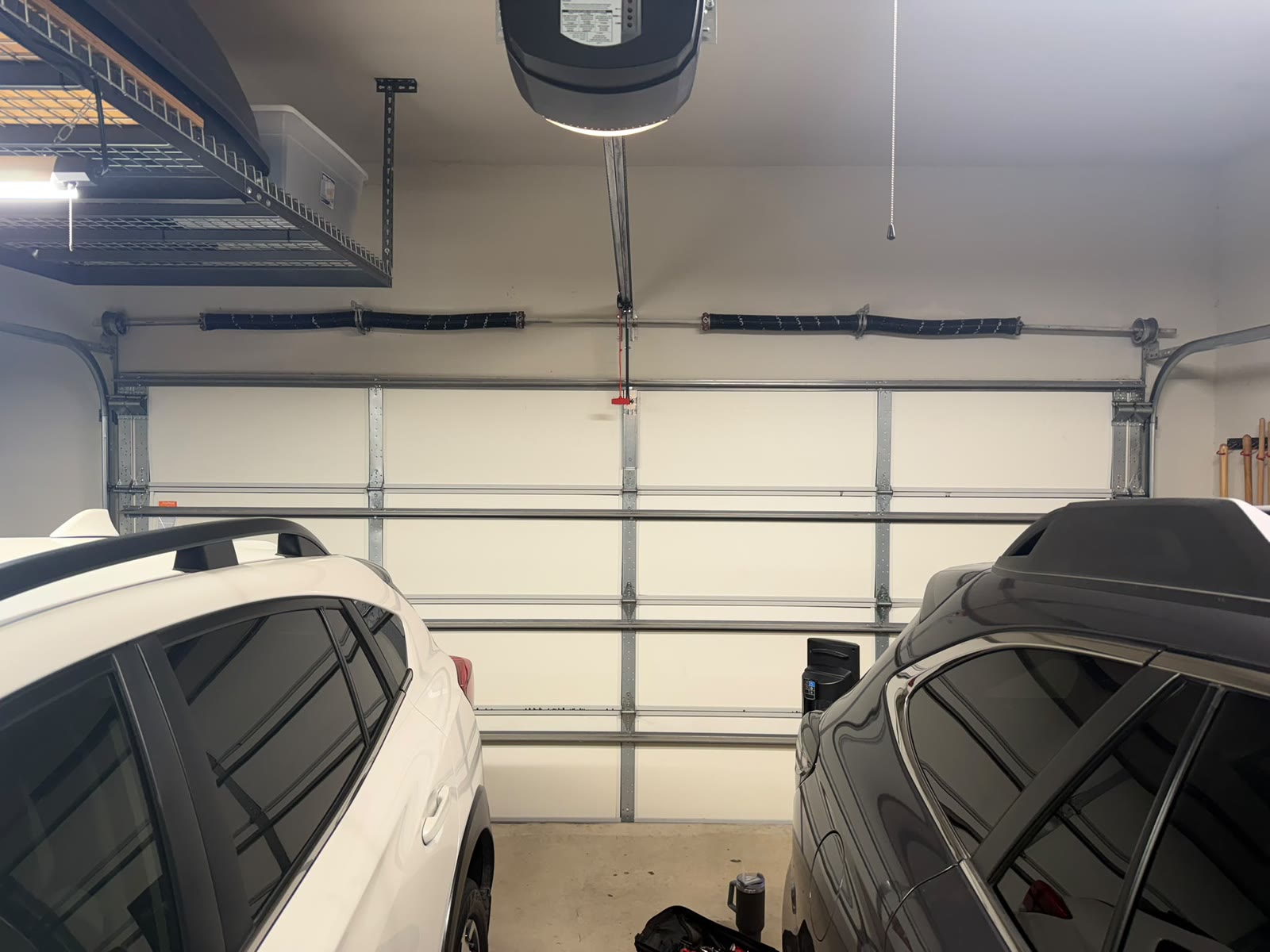
The kits sold for insulating a door you already own are foil faced board or batts that fit into the back of each section. They do lower the inside surface temperature and they do help a hot garage. They also add weight, and that is where it goes wrong.
Your springs were sized for the door as it was built. Add twenty five or forty pounds of insulation across the sections and the counterbalance is now under-sprung for the door it is holding. The door feels heavy by hand, the opener carries the difference on every cycle, and the springs run through their cycle life early. If you add a kit, the counterbalance has to be re-rated for the new weight. That is not an upsell, it is the same weight math that governs a new door.
The second failure is sagging. A cheap kit held in with tape or two clips works loose, hangs into the path of the rollers or the track, and catches. A kit that sags is worse than no kit, because now you have a door that binds as well as a garage that is still hot. If you are going to do it, use a kit that mechanically retains the panels and expect to have the springs looked at afterward.
Adding insulation changes the door's weight and the spring math
After a retrofit kit goes on, the springs have to be re-rated for the heavier door, and that is a job for somebody with winding bars and a spring chart. Never wind, unwind, or adjust a torsion spring yourself. A wound spring stores enough energy to break bone when a bar slips, and hanging extra weight on an already loaded door does not make it any safer to touch.
Need this done?
We handle new garage door installation across Fort Worth and the western metroplex. Call (214) 831-2545 or book online.
Questions
Common questions
Is insulation worth it if the garage is not heated or cooled?
It depends on what is above it and what you do in there. Parking only, nothing conditioned next to it, and the payback is comfort during the hours you are out there, which for a lot of people is not much. Room above, workshop inside, or a door straight into the kitchen, and the insulated door is clearly the better buy.
What R-value should I be looking for?
Rather than chase a number, look at how the insulation is made. Cut polystyrene board lands around R-6 to R-9 and injected polyurethane lands around R-12 to R-18 while also bonding the two steel skins together. The foam doors are stiffer as well as warmer, and the stiffness is what keeps hardware tight over the years.
Will an insulated door lower my electric bill?
Only if the garage is next to or under conditioned space. If there is a room over the garage or a shared wall with one, you are pulling load off the air conditioner that serves that room all summer. If the garage is detached and nothing conditioned touches it, treat the insulated door as a comfort purchase and buy it on that basis.
Are the DIY insulation kits any good?
They do lower the inside surface temperature and they help a hot garage. Two cautions. They add weight the springs were never sized for, so the counterbalance has to be re-rated afterward. And a cheap kit that sags into the track path is worse than nothing, so use one that mechanically holds the panels in place.
Does an insulated door make the door quieter?
A three layer bonded door is noticeably quieter than a single layer one, because a stiff panel does not drum and flex on every start and stop. That said, most of the noise on a typical door is hardware, so sealed nylon rollers and tight hinge and track fasteners usually make more difference than the panel does.
More advice
Keep reading
Choosing A New Garage Door Without Getting Talked Into One
Two garage doors can look identical in a driveway and be a long way apart in what they are made of. Here is what actually drives the number on a quote, and how to compare two of them honestly.
Buying GuideSteel, Wood Or Composite: What Survives North Texas
For most houses on this side of the metroplex the answer is insulated steel, and we will say why in one paragraph before explaining anything. Then the honest case for and against every other material.
Buying GuideWhat Not To Overpay For On A Garage Door Repair
Openers replaced over a stripped gear, whole doors sold over one dented panel, new track that only needed adjusting. Here is the item by item breakdown, including the upgrades that really are worth the money.