Springs
How Long Garage Door Springs Last, Counted In Cycles Not Years
One cycle is one trip up and one trip down, and a standard spring is rated around 10,000 of them. Divide by how often your door runs and you have your answer, plus what makes the real number come in lower.
The short version
- One cycle is one trip up and one down, and a standard spring is rated around 10,000 of them.
- Undersizing, rust pitting, dry coils, poor balance, and running on one broken spring are what actually shorten spring life.
- Cold weather picks the morning a fatigued spring breaks but does not cause the fatigue.
- Lubrication twice a year removes two accelerators but never changes the cycle rating.
Garage door springs are not rated in years. They are rated in cycles, and one cycle is one trip up and one trip back down. A standard residential torsion spring is rated at about 10,000 cycles. If the garage is how your family comes and goes and the door runs six times a day, that is 2,190 cycles a year, and 10,000 divided by 2,190 is about four and a half years. If the door runs twice a day, that is 730 a year, and the same spring lasts around fourteen.
That is the whole answer. The rest of this is what pushes your particular door off that number, how to see the failure coming, and when a spring rated higher than 10,000 is worth buying.
The arithmetic, laid out by how often you use the door
Find your line. Cycles per day times 365 gives cycles per year, and the rating divided by that gives years.
- Two cycles a day, about 730 a year: a 10,000 cycle spring lasts roughly 14 years, a 20,000 about 27, a 50,000 outlives the door
- Four cycles a day, about 1,460 a year: 10,000 gives about 7 years, 20,000 about 14, 50,000 about 34
- Six cycles a day, about 2,190 a year: 10,000 gives about 4 and a half years, 20,000 about 9, 50,000 about 23
- Eight cycles a day, about 2,920 a year: 10,000 gives about 3 and a half years, 20,000 about 7, 50,000 about 17
- Twelve cycles a day, about 4,380 a year, which is a house with teenage drivers: 10,000 gives a little over 2 years, 20,000 about 4 and a half, 50,000 about 11
Count honestly, because most people guess low. Every car that leaves and comes back is two cycles, not one. Add the dog going out, the trash going to the curb, the mower on Saturday, and a teenager who forgot something. A two car household that uses the garage as the front door lands on six to eight without trying, which is why so many doors in Keller, Mansfield, and Burleson break a first spring in year four or five.
What actually shortens spring life
Five things do real damage. Most of what people worry about does not.
- A spring undersized for the door at install, which makes every cycle a harder cycle for the steel
- Rust pitting from humidity, a slab that stays damp, or lake air, because a pit is where the crack starts
- Coil on coil friction with no lubrication, which grinds the surface of the steel every time the spring winds and unwinds
- A door left out of balance, since the spring fights weight it was not sized to hold and the opener fights the spring
- Running the door after the other spring broke, which loads one spring with a job meant for two
The undersized spring is the most common and the most invisible, because a door with the wrong spring still opens. It gets there two ways. A builder spec spring gets chosen for the lightest version of a door model, then a heavier insulated door or a glass top section goes on the same hardware. Or somebody adds an insulation kit to an existing steel door, which adds real weight to a double, and nobody adjusts the counterbalance.
Rust is a local problem. Around Eagle Mountain Lake, Lake Granbury, Benbrook Lake, and anywhere a slab wicks moisture, springs pit years earlier than they should. The spring does not fail across a clean coil. It fails at the pit, so a spring that should have made 10,000 goes at six or seven.
What does not shorten spring life
Cold weather does not wear a spring out. That is worth saying plainly, because a spring that breaks on the first freezing morning feels like weather damage. Steel is less forgiving when it is cold, and the spring sits at its highest stress overnight with the door closed and the spring fully wound. So a spring with fatigue cracks already in it lets go on the cold morning instead of the warm afternoon. The cold picked the moment. It did not shorten the life.
Normal use does not shorten it either, in the way people mean. Using the opener rather than lifting by hand makes no difference, since the spring does the same work either way. Neither does closing the door with the remote from the driveway. And you did not break it. A fatigue part reaching the end of a counted life is the system working as designed.
The warning signs a spring gives before it goes
Springs usually announce themselves for a few weeks first. Watch for these.
- The door feels heavier by hand, or will not hold position at waist height with the opener disconnected
- The opener labors on the way up, sounds slower than it used to, or reverses partway before finishing
- The door lifts crooked, with one side leading the other by an inch or more
- A squeal or a dry grinding sound from the coils as the door moves
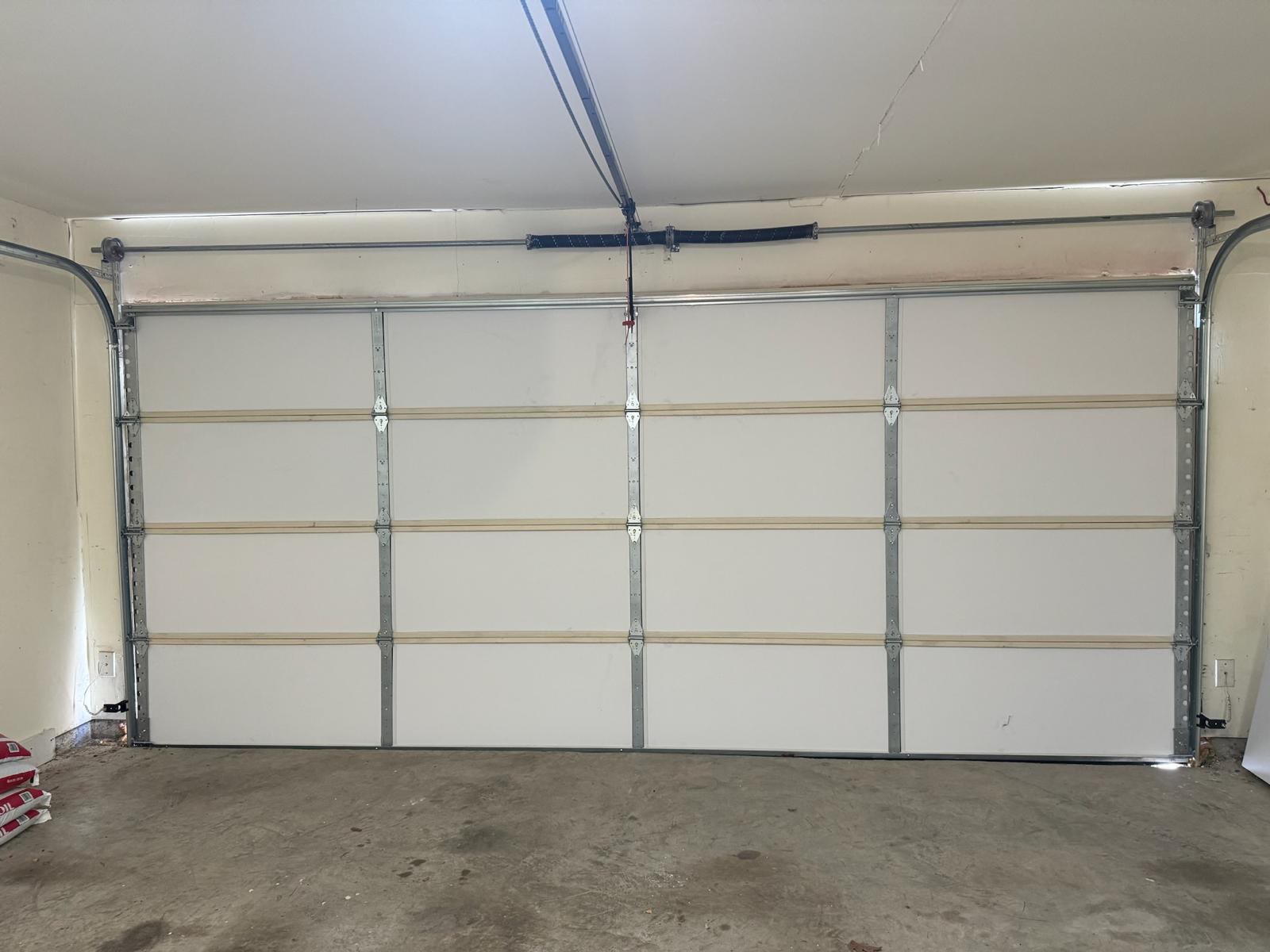
- Rust bloom, flaking, or pitting on the coils, or a gap opening between coils that used to sit tight
The balance test is the one worth doing yourself and it takes a minute. Close the door. Pull the red release handle to disconnect the opener. Lift the door by hand to about waist height and let go. A balanced door takes around ten pounds of effort and stays where you left it. If it slides down, the springs are losing tension. If it wants to fly up, there is too much. Do not run this test if you already heard a bang, because then the full weight of the door is on you.
What lubrication really does, and what it does not
Greasing the coils helps, at the margin. Use a garage door lubricant or a silicone spray, wipe dusty coils down first, and lay a light coat along the spring twice a year. Do the end bearings, the hinge pivots, and the roller stems while you are there. That cuts coil on coil friction and slows rust, which removes two of the five items above, and it quiets the door. There is no reason to pay anyone for it.
Here is the honest limit. Lubrication does not change the cycle rating. A spotless, well oiled 10,000 cycle spring is still a 10,000 cycle spring, because fatigue comes from steel flexing under load, not from friction. Oil buys back the life that rust and grinding would have stolen. It does not add life that was never rated in. And do not spray the track. Rollers are meant to roll along a dry track, and grease there just collects the dust that blows across this county all summer.
When high cycle springs are worth the money and when they are not
A high cycle spring is thicker wire wound into more coils over a greater length, so the same work spreads across more steel and the stress per cycle drops. That is where the rating comes from. It is real engineering, not a label, and it costs more up front.
It is worth it when the door runs six or more cycles a day, when the garage is the family's main entrance, on a heavy insulated double, and on shop and barn doors out in Parker, Wise, and Hood County that run all day. It is not worth it on a two cycle a day door with fourteen years already in front of it, and it is not worth it on a door with cracked sections or a rusted bottom that will be replaced before the springs finish. Put the money where the cycles are.
Do the math on your own door tonight
Count the trips your door makes on an average day, double the number of car departures, and multiply by 365. Divide 10,000 by that. If the answer is smaller than the age of your door, you are on borrowed springs, and the balance test is worth doing this week rather than after the next cold front.
Never adjust or unwind a torsion spring to fix a balance problem
A torsion spring holds its stored energy at all times, and adding or removing turns means holding the full torque of that spring on two steel bars while a set screw is loose. Screwdrivers and pieces of rebar are what people reach for, and a bar coming out of a cone under that load travels fast enough to break bone. A door that fails the balance test needs the tension set with the right bars by someone standing out of the arc.
Need this done?
We handle broken spring replacement across Fort Worth and the western metroplex. Call (214) 831-2545 or book online.
Questions
Common questions
How many years should I expect from my springs?
Divide the cycle rating by how many times a day the door runs, times 365. A standard 10,000 cycle spring gives about fourteen years at two cycles a day and about four and a half at six. The usage number matters far more than the age of the house.
Does opening the door more often really wear the springs out faster?
Yes, and that is the point of a cycle rating. Every cycle flexes the steel under full load, and the rating counts how many of those flexes the wire is engineered to survive. Two families with identical doors can be five years apart on spring replacement purely because of how often they drive in and out.
Will lubricating my springs make them last longer?
It helps but it does not change the rating. A light coat of garage door lubricant or silicone spray twice a year reduces coil on coil friction and slows rust, which are two of the real accelerators. It cannot add cycles that were never engineered into the wire.
My spring broke after three years. Was it defective?
Usually it was either undersized for the door or the door runs far more cycles than the owner assumed. A spring picked for a lighter version of the same door model, or an insulation kit added later, makes every cycle harder on the steel. Rust pitting from a damp slab or lake humidity is the other common cause of an early break.
Should I replace the springs before they break?
It is worth considering once the arithmetic says you are past the rating, especially if the balance test shows the door drifting down. Planned replacement means a scheduled visit instead of a morning with a car trapped inside. It also means the cables, bearings, and rollers get looked at while the door is already apart.
Do high cycle springs make sense on every door?
No. On a door that runs twice a day a standard spring already lasts around fourteen years, so the upgrade buys time you are unlikely to use. High cycle earns its cost on doors running six or more cycles a day, heavy insulated doubles, and shop doors that run all day.
More advice
Keep reading
What A Spring Job Actually Costs, And Why Quotes Vary So Much
The price of a spring job depends on wire size, door weight, spring count, and whether the door got run after the break. Here is the whole cost structure, including what honestly makes a number go up once the tech is standing in your driveway.
SpringsTorsion Springs Or Extension Springs, And Why It Matters On Your Door
Look up: springs on a shaft above the opening are torsion, long springs along the side tracks are extension. Here is how each one lifts your door, what fails, and why one of them needs a safety cable it may not have.
SafetyPhoto Eye Sensors: What The Blinking Light Means And How To Fix It
Photo eyes are the most misunderstood part on a garage door and the easiest one to fix yourself. Here is how the pair works, what the blinking light means, and the one finding that gets reported before anything else.